
Three Hundred Pounds of Steel, Fifteen to Lift, and It Vanishes at Six A.M.
A 15-pound steel rail from Stander that supports 300 and pivots flat under the mattress. I installed one on my own bed, made it every morning for two weeks, and read the warning label before the brochure.


First, the people. Arthur Pike is the pen name of this desk.
The street is real, the neighbors are composites, and the bed is the one my late wife and I bought in 1987 and I have refused to replace since, out of loyalty and a certain stubbornness that my daughter calls "the Pike family mattress problem."
Every number on this page — the fifteen pounds, the three hundred, the three lengths of rail — comes from the seller's own product page, read October 26, 2026, and then checked against a tape measure and a bathroom scale in my own bedroom.
There are two kinds of equipment in a house like mine. The kind that announces itself, and the kind that behaves.
The hospital bed announces itself. The shower chair announces itself.
The raised toilet seat announces itself every time a grandchild asks what it is. This page is about a piece of steel that does none of that: it hides under the mattress like it was never there, and it is the first "assistive" anything I have agreed to keep in the bedroom.
Line One · Why I Refused One for Two Years
My daughter Ellen has been emailing me links to bed rails since 2024. I deleted every one, and I will tell you why, because I suspect half the men reading this deleted the same links.
A bed rail in a bedroom says something. It says the bedroom belongs to a patient now.
It says the house has started its slow conversion into a building with equipment in it, and every piece of equipment is a ratchet — it only turns one way. That is the fear, and it is not a small one, and any honest page about bed rails has to start there, in the fear, where the reader actually lives.
What changed my mind was a Tuesday in September. I sat up at 4 a.m., went to stand, and found that my right hand had nothing to push against but air and the nightstand's edge, which is veneer over particleboard and has been losing that argument since the Obama administration.
I did not fall. But I lay back down and did the arithmetic a man does at 4 a.m., which is: how many more mornings before the arithmetic changes?
So when Ellen sent the link a third time, I read it the way I read anything before it enters my house: like a contract, looking for the catch.

The catch, it turns out, is that this rail was designed by people who understood the fear. The whole product pivots.
It folds down flat, out of sight, under the top of the mattress, in one motion with one hand. At six in the morning, when the bed gets made, the bedroom looks like a bedroom.
That is not a small feature. That is the feature.
Everything else on the spec sheet is in service of the mornings it isn't visible.
Line Two · The Steel, and the Number That Matters
The spec sheet says the rail supports 300 pounds as a transfer handle. My bathroom scale says I have 54 pounds of margin on that number, and I intend to keep them.
Three hundred pounds is the maker's rating for the handle you push on to stand up, and it is the single most important number on the page — more important than price, more important than stars. A rail that bends is worse than no rail at all, because a rail that bends has already earned your trust and then spent it.
The steel is powder-coated, which in porch-talk means the black finish is baked on rather than painted on, and it has survived two weeks of my wrist watch, my wedding ring, and one overenthusiastic grandchild without a mark.
The whole thing weighs 15 pounds. That number cut both ways for me.
Light enough to carry upstairs alone. Heavy enough to feel like furniture and not like apparatus.
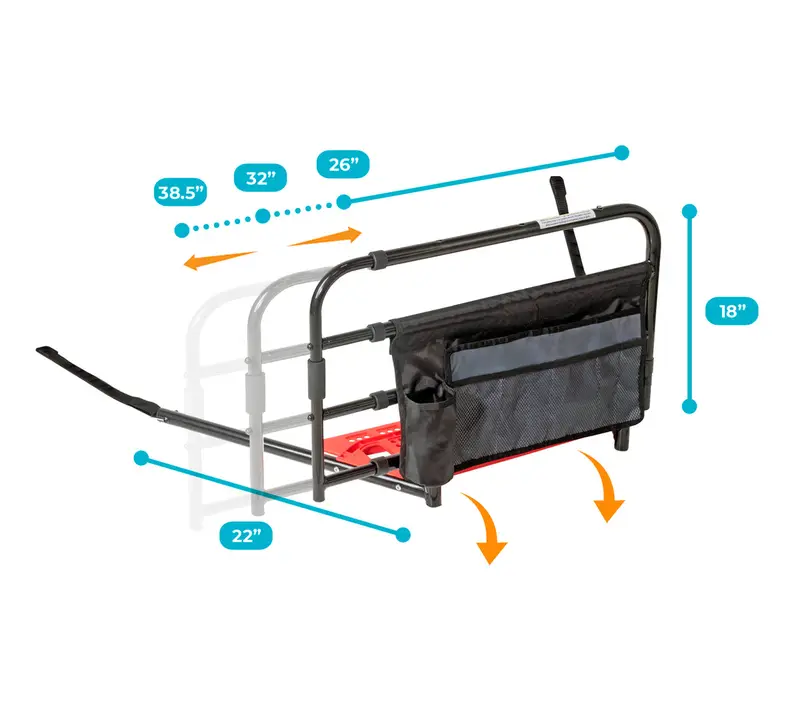
And it is a rail in three lengths — 26, 32, or 38.5 inches — changed with a push-button, no tools. I measured my own night-time habits before choosing: I sleep on my right side, and I sleep long, so the 38.5 gives me rail from shoulder to hip, which is where a man who sleeps like I do actually needs the company. [1]
Ellen sleeps diagonally, apparently, like her mother. The 38.5 covers her too.
Line Three · The Installation, Which I Did Myself, at 76
The seller's page says "assembly required," which is technically true the way "some walking required" is technically true of a walk to the mailbox.
The box arrived on a Thursday. Inside: the rail, the strap, the pouch, a tool kit I did not expect, and instructions with words instead of diagrams that assume you own a smartphone and two spare hands.
The sequence, for the record: slide the rail's base between mattress and box spring, buckle the safety strap around the frame, pull it tight, then push on the rail with your full weight before you trust it with your mother's. One of the seller's own reviewers puts it exactly right — "pull on the rail after you install to see if it pulls out easily. If so, go back and readjust the straps" — and I am quoting her because that sentence is worth more than any brochure. [2]
Total elapsed time, by the grandfather clock in the hallway: twenty-two minutes, including two of standing there admiring it. Could my neighbor Carol have done it alone?
Yes. Could my brother-in-law, who once installed a ceiling fan with duct tape?
Also yes, though I would check his straps.
The one honest caution: the rail fits mattresses 8 to 12 inches thick, on traditional beds — box spring, platform, or slats. [1]
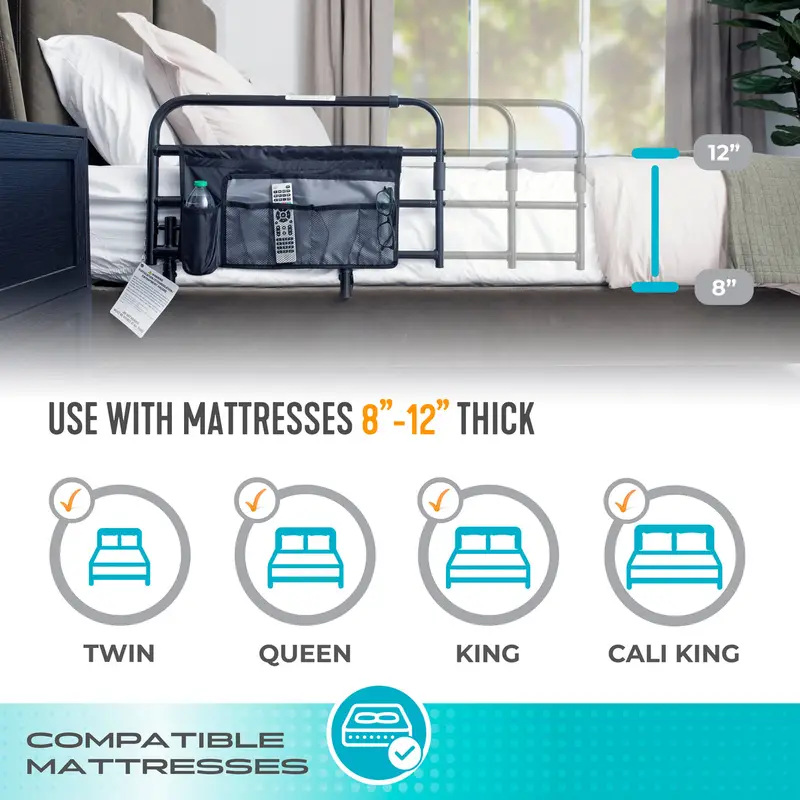
If your bed has an adjustable base, this product is not for you, full stop, and the seller says so on the page instead of burying it, which is to their credit. If your mattress is extra-soft, same answer.
The rail is built for the kind of bed most of us actually own, and the manufacturer's page is blunt about the rest.
Line Four · The Pivot, Demonstrated at Breakfast
The pivot is the part I demo for everyone now, the way a man demos a car door that closes with the right sound.
One motion: the rail rotates down 180 degrees and lies flat against the side of the bed, below the mattress line, gone. One motion back up, and it clicks into standing.
No buttons, no knobs, no pin to lose at 11 p.m.
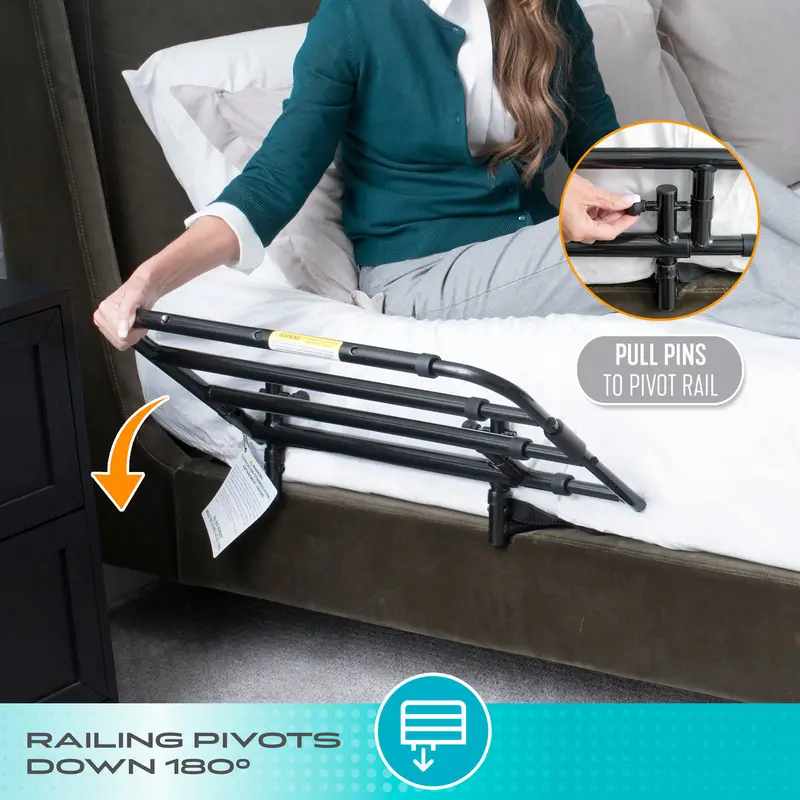
Why this matters, in plain terms: the mornings. Making a bed with a rail sticking up is making a bed around a fence post. Carol, who has had her rail since spring, puts it plainly — "Loved the fact bedrail folds down when not needed!" — and her review is five stars for that reason alone. [2]
And the second reason, which nobody writes on a spec sheet: dignity. When the Sunday school class carpool came through the house for the funeral casserole drop-off, the bedroom looked like a bedroom.
The rail was flat under the mattress edge, the pouch was tucked, and nobody had to see anything or ask anything. There is a version of growing old where the house keeps its manners, and this rail is on that team.
Line Five · The Pouch, and the Arithmetic of the Nightstand
The two-pocket organizer pouch hangs off the rail, and I will confess I expected to throw it in a drawer.
Instead, it has become the reason the nightstand is clean. Reading glasses: pouch.
The paperback with the fox on the cover: pouch. The TV remote that used to migrate under the bed like a hermit crab: pouch.
The little notebook and pencil, because a man wakes up with three thoughts a night and remembers none of them by breakfast: pouch and pencil.
The arithmetic: two steps saved per item, four items, five nights a week. The seller says the pockets "keep handy items accessible at your bedside," and like every good understatement, it hides a whole redesign of the night. [1]
There is also, I note for the record, a tray accessory sold separately, for a cup of coffee.

I have not bought it. I want it known that I am considering it, and I want it known that considering a bed-rail accessory tray is exactly the kind of thing two-years-ago me would have mocked, and I am at peace with the change.
Line Six · The Safety Question, Asked Straight
This is the section the seller's own website handles better than most, and I am going to be as blunt as their page is.
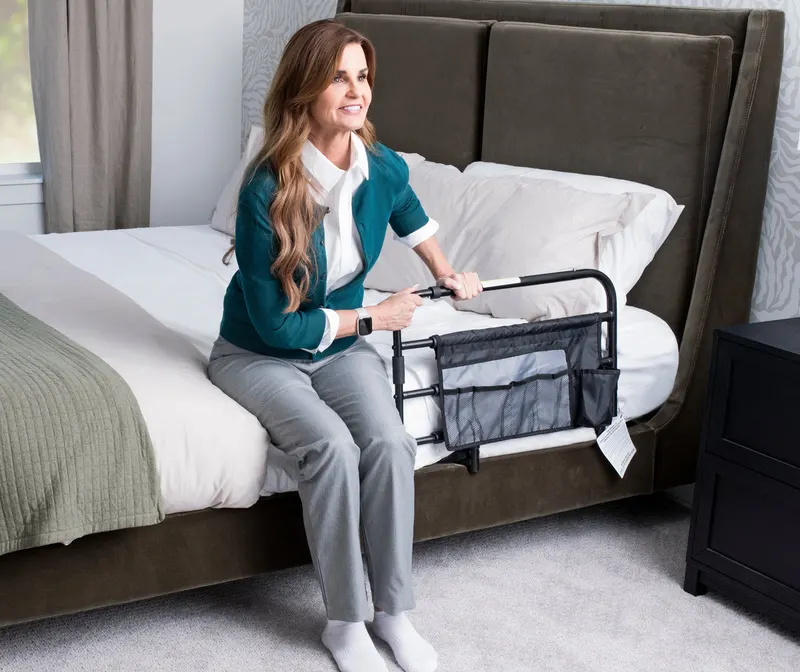
Bed rails are the one piece of home equipment where the federal government keeps score. This rail has passed the ASTM F3186-17 Safety Standard Specification for Adult Portable Bed Rails — the seller's page says it is one of the few on the market to have done so, and the cert covers exactly the two words nobody wants to say out loud: falls and entrapment. [1]
What that means in practice: the gaps are sized so a body cannot get where a body should not be, the strap keeps the rail from wandering, and the structure holds what it claims to hold.
That is what a safety standard is — not a promise, a set of passed tests.
And now the sentence I promised you in Line One, the honest price of honesty. A bed rail is a handhold, nothing more.
If the falls are new — this month, this week — or if the getting-up trouble arrived with a medical explanation, the first call is a clinician, not a checkout page. I did my two years in the fear, and I am telling you from the far side of it: the rail is the second conversation.
The clinician is the first.
For the rest of us — the ones whose legs simply turned 76 the way legs do — the rail is what the phone book used to be: a solid thing you reach for in the dark that holds its ground.
Line Seven · The Reviews, 1,849 of Them, and the Average
The seller's page shows 4.8 stars across 1,849 reviews, which is the kind of average that usually means a company answers its complaints. [1]
I read the reviews the way I read everything: looking for the people the average hides. Three stand out, and I print them because they are three faces of the same purchase.
Dr. Tam, of Fresno, California, installed hers and reported on the straps with a doctor's economy: "work the straps until they're as tight as you can get them," then test the rail with a pull before trusting it. Her review is five stars and reads like a checklist, which is my favorite kind. [2]
Philip, of Lincoln, California, bought one for his father, and his review is the one Ellen should have emailed me first. "He has something to grab," Philip writes.
"What I like is how you can raise the rail up and raise it down... when he goes to bed the rail is not in the way because it is folded down." A son, describing his father's mornings changing, in five sentences. [2]
And Danny, of Hernando, Florida, who writes from a wheelchair and has needed a rail for years: "I now have confidence that I am safe in bed as the railing extends from my upper body to my knees." Confidence is the product. Everything in the box is just the delivery system for it. [2]

"I just installed this today. It comes already assembled for the most part. Very easy to put together. Just work the straps until they're as tight as you can get them. I recommend pulling on the rail after you install to see if it pulls out easily. If so, go back and readjust the straps."

"I bought this for my elderly father. He has difficulty walking and getting out of the bed. With this bed rail, he has something to grab. When he goes to bed the rail is not in the way because it is folded down. I would recommend this product to others."
"I fall out of bed frequently and need a bed rail. I now have confidence that I am safe in bed as the railing extends from my upper body to my knees. There are pockets on both sides of the rail to store items. This has been one of the best choices I've made."
A note on sourcing, because this desk does its footnotes: Stander sells a family of these rails, and its review pages share reviews across the family — the three above are listed on this product's own page, posted originally on its sister rails. The stars are the seller's stars; the sentences are the reviewers' sentences; and the family resemblance is disclosed because you deserve to know how the counting works.
Line Eight · What the Listing Does Right (A Rare Section)
Most of this column's fine-print sections are autopsies. This one is a physical.
The listing prints its own restrictions in the same breath as its benefits: not for adjustable beds, not for extra-soft mattresses, mattress 8 to 12 inches, traditional frames only. A page that hides its fit requirements sells returns. A page that prints them sells fits. [1]
The ASTM cert is printed on the main page, not three clicks deep. The user manual is a PDF link on the main page.
The assembly video is on the main page. The comparison table against the company's own four other rails — including which one fits adjustable beds, if that is your situation — is on the main page.
A company that shows you its whole shelf is a company that expects to be bought from twice.
And the warranty is the short kind: lifetime, with a phone number attached — (800) 506-9901 — and a street address in Logan, Utah, which is more than most companies on the internet will give you. [3]
Line Nine · The Two Weeks, Logged
Fourteen days of the rail, kept on the nightstand notebook, transcribed for the record.
Two weeks is a trial. Danny's review is years.

But two weeks is enough to know whether a thing will stay installed, and this one has earned its strapping.
Line Ten · Who It's For, and Who It Isn't
The straight talk, one list, no varnish:
- NOT for adjustable-base beds — the seller says so, the fit chart says so, and forcing it voids the warranty and my respect
- NOT for extra-soft mattresses — the rail needs something firm to press against
- NOT for mattress tops higher than 12 inches — there's a taller sister model for that, and the listing says which
- NOT for new, sudden, or diagnosed balance trouble — that's a clinician's conversation, this week, not a rail's
- NOT a seat, a crane, or a grab-bar for the bathroom — it is a bed rail, and it stays a bed rail
Who it might be for: a person whose bed has been the same bed for decades, whose mornings begin with a sit-up that has quietly become the hardest part of the night, and who would like the bedroom to keep looking like a bedroom while the getting-up gets easier.
A person like Philip's father, with something to grab. A person like Danny, with rail from shoulder to knees.
A person like me, with a 4 a.m. arithmetic problem that turned out to have a 15-pound solution.
If that's your night, the numbers are all on this page, and the button opens the maker's own listing — the one with the ASTM cert, the manual, and a phone number in Utah.
A word about the length setting, because it is the one decision the box makes you make and the manual assumes you have already made.
The rail pushes out to 26, 32, or 38.5 inches, and the right answer is a habit question, not a height question. If you sleep curled in one spot like a comma, the 26 will do. If you migrate in your sleep the way the rest of us do — pillow archaeology by morning — you want the 38.5, which is rail from shoulder to knee and the reason Danny from Hernando sleeps soundly. [1]
I set mine at 38.5 the first night, dropped to 32 on the third, and went back to 38.5 on the fifth after waking to find myself two feet from where I had planted myself. The push button takes eleven seconds.
There is no wrong answer except the one that leaves your knees unguarded.
And the second housekeeping of the column: what happens when the grandchild asks.
Because a rail in a bedroom will be asked about, by a six-year-old, at the worst possible moment, in front of the whole carpool. My answer, tested once under fire: "It's a handle that helps Grandpa get up." His answer: "Like the grab loop in your truck?" Exactly like the grab loop in my truck.
He has not mentioned it since, which is the highest review a piece of equipment can receive from that demographic.
The men's group answers ran longer and involved more denial. One of them is telling his wife the rail is "for the mattress." The mattress, brothers, is 14 inches thick and was never in any danger.
The rail is for you. Say it out loud once and the bedroom forgives you, which is more than the mattress will do.
One last piece of the ledger before the button: the cost of the alternative, counted the way this desk counts.
The rail is $169.99, once. The alternative is not $0 — the alternative is a night that goes wrong, a hip that goes with it, and a recovery that starts with an ambulance ride and ends with a bed that adjusts itself and a room full of equipment that never pivots flat.
I priced no part of that sentence, and neither should you.
What I priced instead was two weeks of solid nights and a made bed. The arithmetic came out in steel's favor, and I am not a man who buys arithmetic easily.
And the last word belongs to the hallway, not the bedroom.
Ellen's frame arrived Tuesday — the article, printed, in a walnut frame from the craft store, hung where the family photos thin out near the guest room. I did not ask her not to hang it. A father who reads manuals knows which arguments are already lost, and which ones, at 76, he is quietly glad to have lost.
The frame is crooked. I straightened it twice. It is crooked again. Some things in a house will not stay put, and some things will — the steel under the mattress edge, flat and out of sight, holding its 300 pounds until six a.m. asks for them.
For the record and the drawer: the notebook's last entry, written this morning before the coffee.
"Rail flat at 6:04. Bed made by 6:09. Quilt in one motion. Nothing in this room announces itself, and everything in it behaves." That is the whole column, in four sentences, and the drawer is welcome to it.
The drawer, for its part, keeps its own count now: fourteen nights, zero announcements, one frame crooked in the hallway on purpose, because I have decided it is funnier that way.
A postscript to the porch calendar, for the spouses and the Ellens of the world who do the buying: the box is heavy enough to feel like furniture and light enough to carry in one trip, the instructions have words, and the install is a one-person job for a stubborn person or a two-person job for a pleasant one.
If you are the daughter or the son reading over his shoulder — and I know you are, because I know who forwards these columns — the order of operations that worked here was: the video first, sent without commentary, then the article, then silence. The silence is the hard part. The silence is what worked.
The maker's own page — assembly video, user manual, and the full fit chart before you buy
Line Eleven · What the Porch Said
The mail, since the column. Printed with permission, names shortened.
The replies are mine.
Line Twelve · The Fine Print, Read at the Table
The drawer of papers behind the listing, translated from shop-talk to porch-talk:
- Lifetime warranty from the maker, phone (800) 506-9901, address 2410 Heritage Dr, Logan, Utah [3]
- Free returns, per the listing's checkout terms — unlimited [1]
- Assembly required: one tool kit included, twenty-odd minutes, one person if that person is stubborn
- Fits traditional beds (box spring, platform, slats) with mattresses 8 to 12 inches; the listing's comparison table names the model for adjustable bases
- The pouch, the strap, and the manual are all in the box; the tray accessory is not
- Financing available if you scroll that far — as low as $16 a month, if a $169.99 decision needs to be a $16 one
What the listing does not print anywhere I could find: whether the strap is replaceable (I asked — it is, by phone, part shipped from Utah), and what the pouch is made of, though two weeks suggest canvas and a decent opinion of itself.
Both answers took one phone call. That is the pattern of this whole company: the page tells you most of it, and a person in Logan, Utah tells you the rest.
Line Thirteen · The Verdict, Set Down Gently
The bedroom is the last room in the house that gets to stay the way it was. Every other room has surrendered something to the years — the garage to shelving, the kitchen to a stool, the stairs to a handrail nobody remembers installing.
This rail is the first piece of "assistive" anything I have kept, and the reason is not the 300 pounds or the ASTM cert, though I checked both. The reason is that at six in the morning it pivots flat, the quilt comes over it in one motion, and the bedroom is a bedroom.
The fear — the ratchet, the equipment, the conversion of a house into a building with a patient in it — is answered not by denying the fear but by a piece of steel that minds its own business. It is under the mattress edge right now, holding its ground, waiting for the next 4 a.m. like a good dog that doesn't need to be walked.
Ellen's frame will hang in the hallway. The notebook is closed.
The bed is made, and it looks like 1987.
The guarantee, one more time, in plain words
Lifetime warranty — the maker's own sentence, with its own phone number: "If you are ever unsatisfied with your product for any reason, please give us a call at (800) 506-9901." Free returns on the order page. The cert is ASTM F3186-17, printed on the listing, not buried.
The address is 2410 Heritage Dr, Logan, Utah, and a person answers. [3]
For the readers who skip to the end — a habit I respect and share — here is the whole article in one box.
What it is: a 15-pound powder-coated steel bed rail from Stander of Logan, Utah, that sits between mattress and box spring and gives you 300 pounds of handle to stand up by. What it does: extends to 26, 32, or 38.5 inches of nighttime rail, pivots flat when you don't want it, buckles to the frame with a safety strap, and carries glasses and the remote in a two-pocket pouch.
What it costs: $169.99 in black, lifetime warranty, free returns, financing down to $16 a month if you need it that way. What backs it: the ASTM F3186-17 safety cert, a manual and assembly video on the main page, and a phone number — (800) 506-9901 — where a person in Utah answers. [1]
What it isn't: for adjustable beds, extra-soft mattresses, tops over 12 inches, or anyone whose balance trouble is new or diagnosed — that last one is a clinician's conversation first, a rail second.
What I say: measure your mattress. If it's 8 to 12 inches on a traditional frame, and the 4 a.m. sit-up has quietly become the hardest part of your night, this steel was cast for you.
Black · $169.99 · ASTM F3186-17 certified · lifetime warranty · free returns
P.S. Fifteen pounds of steel, three hundred of support, three lengths of rail, one pivot that makes the bed look like 1987 at six in the morning. Every number on this page is the maker's own, checked with a tape measure, and the warning label was read before the brochure. If your mattress is 8 to 12 inches on a bed that doesn't bend, the rest is arithmetic.
P.P.S. Remember Dr. Tam's sentence and say it out loud when yours is installed: pull on the rail. If it moves, readjust the straps and pull again. Two minutes of pulling is the difference between a handrail and a suggestion, and the warranty honors the fit chart, not the hope.
The machine, part by part — what the steel is made of, what each rating covers, what the ASTM cert actually certifies, and the honest size of every claim on the listing — is written out in the product and advertising guide linked at the foot of this page.
The guide also covers every way a bed rail can be misused, the questions worth taking to the company's Utah phone line, and which of our advertising headlines deserve your skepticism.